

Straight hair looks easy. Then you leave the barbershop, wake up the next morning, and it’s flat on top, sticking out at the sides, or sliding into his eyes.
That’s the catch with boys’ haircuts for straight hair. The hair has no natural bend to hide mistakes. Every line shows. Every weak spot in the cut shows too.
The good news? Straight hair also takes a clean shape better than any other texture. Pick the right cut, and your son gets a sharp, tidy look with almost no effort.
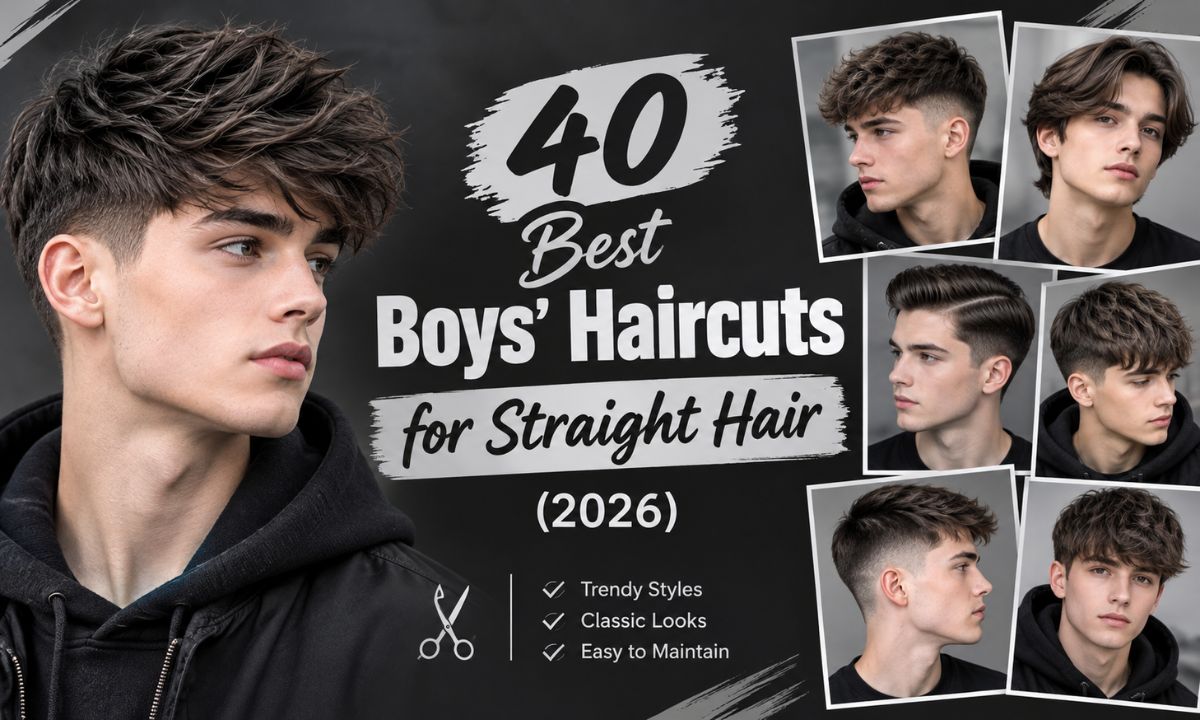
This guide covers 40 of the best straight boy haircuts for 2026. You’ll find short, medium and long options, the newest trends, picks by age, face shape and hair thickness, barber scripts you can copy, school-safe choices, and a realistic look at yearly cost.
Quick answer: The best haircuts for straight hair boys are the textured crop, French crop, side part with a taper, crew cut and Ivy League. All five add shape or texture, and all five grow out neatly.
What Makes Straight Hair Different, and Why Most Haircut Guides Fail It
Most haircut guides are written around one idea: show a photo, copy the photo. That works for wavy or curly hair, where the natural pattern fills in gaps.
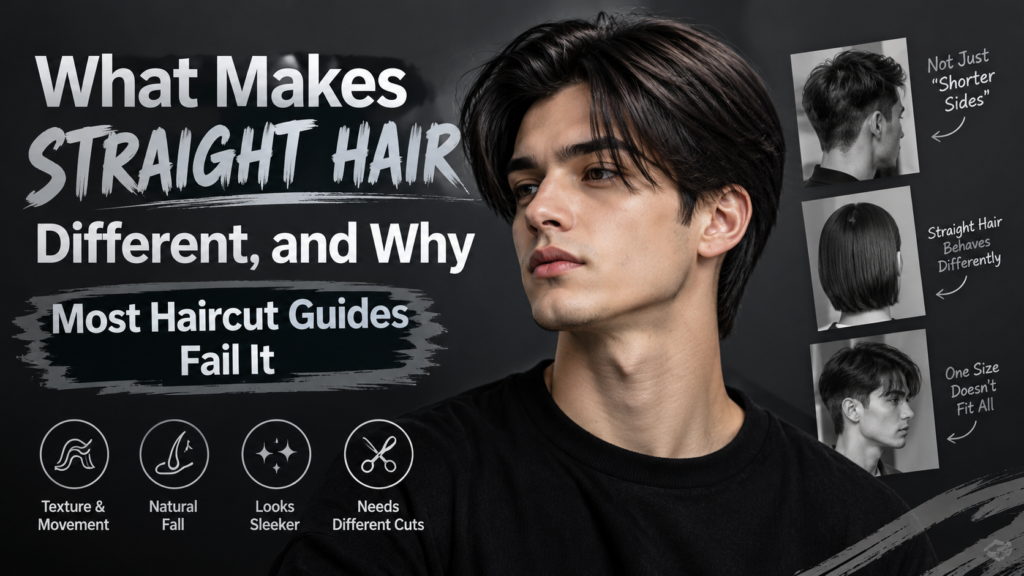
Straight hair doesn’t do that. A strand grows straight down from the scalp, lies flat against the neighbours, and reflects light in a smooth sheet. The result is a surface that shows every clipper line, every uneven layer, and every stray strand.
That’s why a cut that looks great on a curly-haired model can fall apart on a straight-haired kid. The photo was never about the cut. It was about the texture underneath it.
Here are the traits that shape every decision in this guide:
- Strands lie flat. Without lift, hair collapses under its own weight.
- Cowlicks stand out. A crown swirl or front cowlick can’t hide in a curl.
- Natural oil travels fast. Oil slides down a straight strand quickly, so hair can look greasy sooner.
- Shape is visible. A blunt line stays blunt. A choppy line stays choppy.
- Grow-out is honest. A bad cut tells on itself within two weeks.
You’ll also see parents search for straight boy haircuts, boy haircuts for straight hair, haircuts for teens with straight hair, short haircuts for boys with straight hair and good haircuts for straight hair boys. They all point to the same need: a cut that works with the hair, not against it.
The Volume Problem Nobody Talks About
Volume is the number one complaint, and it rarely gets a straight answer.
Straight hair is heavy by structure. Each strand is smooth and stacks neatly. Add length, and gravity pulls the whole mass down. The roots flatten, and the top looks thin even when the hair is thick.
You can’t fix this with a product alone. You fix it with cutting choices:
- Keep the top short enough that it can stand up or sit forward on its own.
- Add internal texture so strands support each other.
- Use a taper or fade so the sides don’t balloon outward.
- Cut around the cowlick, not through it.
Product comes second. Cut comes first.
What Straight Hair Does Well
Don’t let the volume problem scare you off. Straight hair has real strengths:
- It holds crisp lines like fringes, part lines and fades.
- It’s easy to comb and quick to restyle.
- It suits classic cuts that look neat in photos and at school.
- It reacts well to light styling. A pea-sized dab of matte clay does the job.
- It grows out in a predictable shape.
What to Avoid If Your Son Has Straight Hair
Some cuts work against the hair type. Steer clear of these unless there’s a good reason:
| Avoid | Why it fails on straight hair |
| Long, one-length hair with no layers | Falls flat, looks stringy and heavy |
| Very blunt, heavy bowl cut | Looks helmet-like; grows out badly |
| Over-thinned ends | Leaves wispy, see-through edges |
| Spiky gel styles that need strong hold | Strong gel looks stiff and flakes |
| Cutting wet with no regard for the cowlick | The hair springs up differently once dry |
| Razor-thin layers on fine hair | Strands look broken, not textured |
Which Haircut Is Best for Straight Hair Boys?
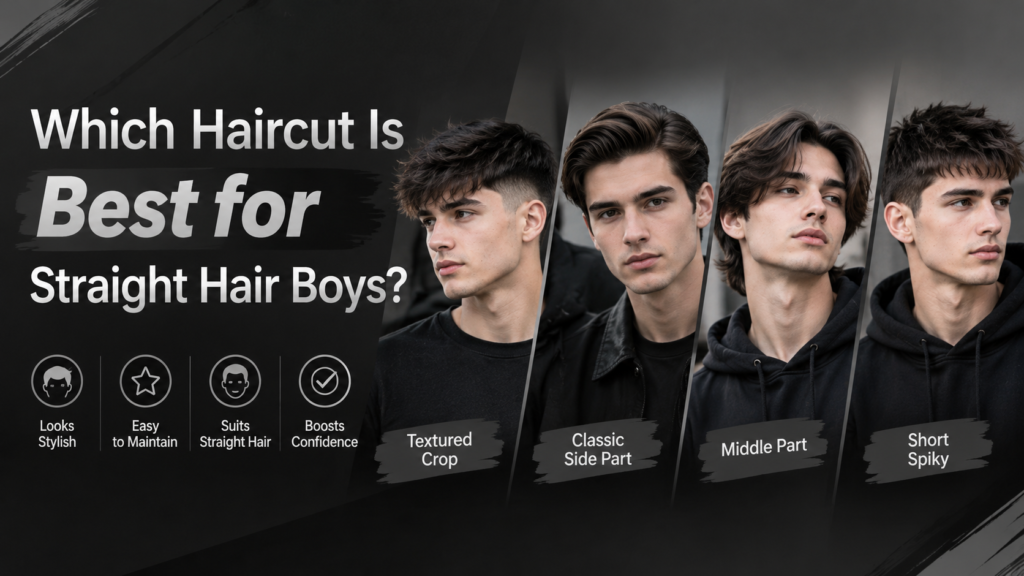
There’s no single winner. The best cut depends on three things: age, face shape and hair thickness. Use the sections below as a quick filter, then jump to the full list.
The Top 3 Picks by Age Group
| Age group | Pick #1 | Pick #2 | Pick #3 |
| Toddlers (2–4) | Classic short back and sides | Soft crew cut | Simple side-swept fringe |
| Kids (5–9) | Textured crop | Side part with low taper | French crop |
| Pre-teens (10–12) | Textured crop with mid fade | Side-swept with fade | Ivy League |
| Teens (13–18) | Two block | Comma hair | Curtain bangs with taper |
If you have a teen reading this: haircuts for teens with straight hair are the most flexible of all. Teens can handle length, product and a few fashion risks.
How to Choose by Face Shape
Face shape changes how a cut sits. Use this as a guide, not a rule.
| Face shape | What it looks like | Cuts that help |
| Oval | Balanced; slightly longer than wide | Almost anything; side part, crop, quiff |
| Round | Soft jaw, full cheeks | Height on top; taper fade; brush-up; avoid heavy fringes |
| Square | Strong jaw, wide forehead | Side swept, textured crop, medium length with softness |
| Oblong | Long face, high forehead | Fringes, curtain bangs, side-swept; avoid tall quiffs |
| Heart | Wide forehead, narrow chin | Side fringe, medium length, soft layers |
How to Choose by Thickness
“Thick” and “fine” describe the strand width. “Dense” and “thin” describe how many strands there are. A child can have fine strands but lots of them.
- Fine hair: Go shorter on top with texture. Skip razor cutting. Volume powder or sea salt spray helps.
- Medium hair: The widest range of cuts work. This is the easy category.
- Thick or coarse hair: Ask for thinning shears or point cutting to remove bulk. Cuts with a taper keep the sides neat.
Short Boys’ Haircuts for Straight Hair
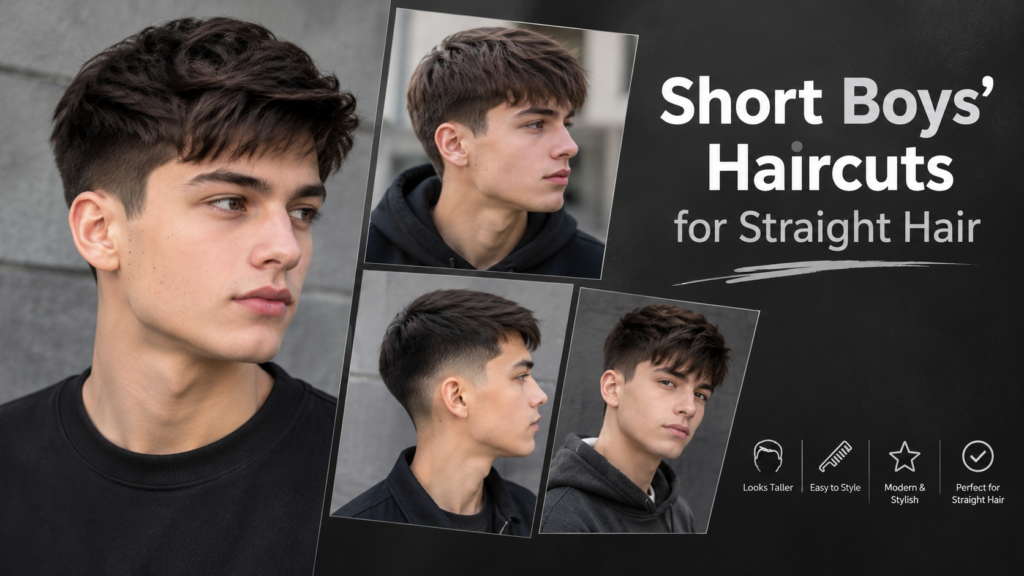
Short haircuts for boys with straight hair are the safest bet for school, sport and busy mornings. They keep the hair light, so it doesn’t collapse. They also let a fade or taper do the visual work.
1. Textured Crop with Mid Fade
The textured crop is the all-rounder. The top is cut short with choppy layers, and the sides fade up to the mid-head.
- Best for: Fine to medium hair, ages 6 and up
- Why it works: The cut creates its own lift, so the top doesn’t lie flat
- Style: Dab of matte paste, push the fringe forward
2. French Crop
A short, blunt fringe sits across the forehead while the sides stay tight. It reads sharp and clean.
- Best for: Straight, medium to thick hair
- Why it works: Straight hair lays forward naturally, and the short length stops it flopping
- Watch for: A crown cowlick can push the fringe sideways, so tell the barber
3. Side Part with Low Fade
The classic neat boy look. A defined part line, longer hair on top, and a low fade around the ears and neck.
- Best for: School, photos, family events
- Why it works: Straight hair makes a crisp part and combs flat in seconds
- Style: Comb while damp, set with light cream
4. Crew Cut
Short on top, shorter on the sides, with the front a touch longer for a slight lift. It’s the simplest cut on the list.
- Best for: Active boys, young kids, hot weather
- Why it works: No styling is needed at all
- Watch for: Fine hair can look sparse if cut too short
5. Edgar Cut
Also called the Takuache, this cut has a blunt, straight fringe cut across the forehead with faded sides. It’s a bold, geometric look.
- Best for: Teens with thick, straight hair
- Why it works: The flat, heavy hair holds the blunt line perfectly
- Note: Many schools accept it, but check the line-up and design rules first
6. Buzz Cut with Line-Up
One guard length all over, with a clean edge along the hairline. It’s the ultimate low-maintenance choice.
- Best for: Summer, sport, any age
- Why it works: Straight hair buzzes evenly, with no cowlick drama
- Tip: A #2 or #3 guard looks less severe than a #1
7. Caesar Cut
Short, even fringe combed forward and cut straight across. It’s like a softer, shorter French crop.
- Best for: Boys who dislike hair in their eyes
- Why it works: Straight strands fall forward and stay put
- Style: Comb forward, add a touch of wax
8. Short Quiff
A short fringe brushed up and slightly back, with tapered sides. It adds height without needing much length.
- Best for: Fine straight hair that struggles for lift
- Why it works: Short length means the hair can actually stand up
- Style: Blow-dry up and back, then finish with clay
9. Taper Fade with Brush-Up
The sides taper gradually, and the top brushes up off the forehead. It’s polished but relaxed.
- Best for: Round faces, because the height lengthens the face
- Why it works: The taper keeps the sides slim, so the top gets the attention
10. Short Back and Sides
An old classic. Scissor-cut or clipper-cut short around the ears and neck, with a longer top.
- Best for: Toddlers and young boys
- Why it works: Simple, gentle on the scalp, and easy to maintain
11. High and Tight
A military-style cut with very short sides and a short top, clipped close.
- Best for: Boys in cadet programmes, sport teams or hot climates
- Why it works: Clean lines and zero upkeep
- Watch for: Looks stern on very young boys
12. Spiky Textured Top
Short, choppy layers styled up with a light-hold product. Think playful rather than punk.
- Best for: Boys who want a fun, energetic look
- Why it works: Short straight strands stand up well with a little paste
- Tip: Use a soft paste, not hard gel
13. Low Skin Fade with Pushed-Forward Fringe
The sides fade down to skin, while a short fringe sweeps forward. Sharp contrast, minimal fuss.
- Best for: Teens who like a defined shape
- Why it works: Contrast hides thin spots and gives structure
14. Butch Cut
A uniform short cut, usually done with a clipper guard. It sits between a buzz cut and a crew cut.
- Best for: Boys who want an easy summer trim
- Why it works: Even length means the hair doesn’t flop or separate
Short Cut Comparison
| Cut | Upkeep | Styling time | School-safe | Best thickness |
| Textured crop | Medium | 2 min | Yes | Fine–medium |
| French crop | Medium | 1 min | Yes | Medium–thick |
| Side part + low fade | Medium | 2 min | Yes | All |
| Crew cut | Low | 0 min | Yes | All |
| Edgar cut | High | 2 min | Check rules | Thick |
| Buzz cut | Very low | 0 min | Yes | All |
| Caesar cut | Low | 1 min | Yes | Medium |
Read More: Caesar Haircut for Men: 25 Best Styles & Trends (2026)
Medium-Length Haircuts for Boys with Straight Hair
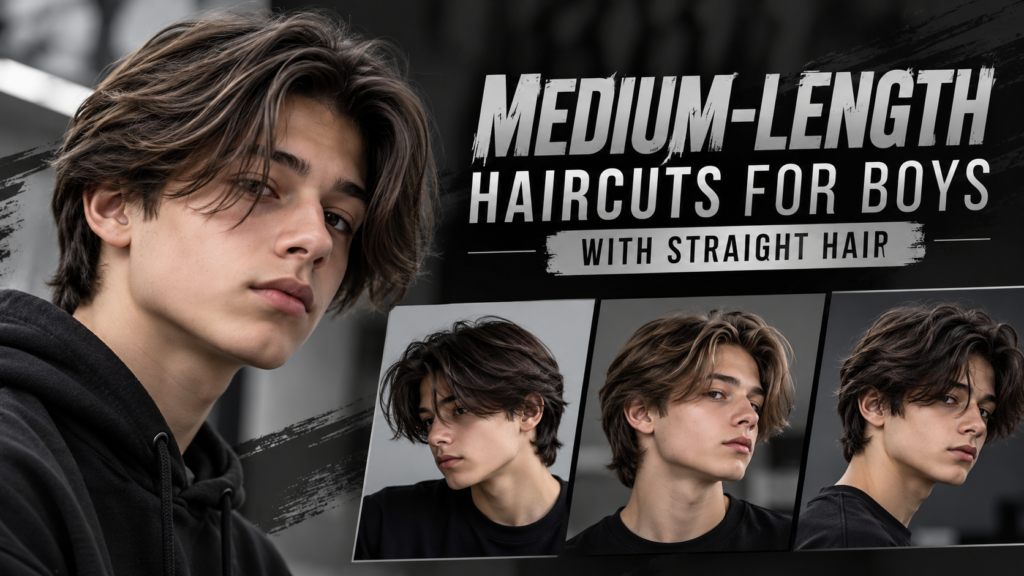
Medium length gives more options, and more ways to go wrong. The top needs enough length to move, but not so much that it hangs flat. Aim for roughly 2 to 4 inches on top.
15. Curtain Bangs with Taper
Centre-parted hair that sweeps to each side like curtains, with a clean taper at the neck and ears.
- Best for: Teens with straight, fine to medium hair
- Why it works: Straight hair falls into the part naturally
- Style: Blow-dry outward with a round brush
16. Two Block
A Korean-inspired cut where the top is longer and the sides and back are cut shorter in a distinct step. It’s a trend that keeps coming back.
- Best for: Thick or coarse straight hair
- Why it works: Removing weight from the sides stops the “mushroom” shape
- Tip: Show a picture to the barber, since “two block” varies a lot
17. Comma Hair
A fringe that curls slightly at the end into a comma shape, pushed to one side of the forehead.
- Best for: Straight hair with a little natural bend
- Why it works: A heat tool or round brush creates the curve
- Reality check: On very pin-straight hair, the curve won’t hold without blow-drying
18. Side Swept with Fade
Hair sweeps across the forehead to one side, and the sides are faded short.
- Best for: Most boys, most face shapes
- Why it works: The sweep covers a wide forehead and adds shape
- Style: Blow-dry sideways, then comb through with a bit of cream
19. Angular Fringe
A fringe cut on an angle, longer on one side and shorter on the other. It’s sharp and directional.
- Best for: Square or round faces
- Why it works: The diagonal line adds structure to flat hair
20. Hard Part with Comb Over
A razor-shaved part line, longer hair combed over, and a fade on the sides.
- Best for: Teens who want a sharp, formal look
- Why it works: Straight hair keeps the comb-over smooth
- Note: The shaved part needs touching up every two weeks
21. Textured Quiff
Longer on top, swept up and back, with a textured finish rather than a slick one.
- Best for: Teens with medium-density straight hair
- Why it works: Texture keeps the quiff from collapsing
- Style: Blow-dry up, then roughen with clay
22. Messy Fringe
A loose, uneven fringe with choppy layers. It looks careless, but it’s cut with care.
- Best for: Boys who hate styling
- Why it works: The layers hide the flatness of straight hair
23. Soft Layers with Taper
Light layering through the top, with a tapered back and sides. It gives gentle movement without losing neatness.
- Best for: Boys with thick, heavy straight hair
- Why it works: Layers release weight, so hair can move
24. Mini Pompadour
A shorter, scaled-down pompadour with height at the front and shorter sides.
- Best for: Boys with fine hair who want a statement
- Why it works: A blow-dryer and powder create lift
- Honest note: It needs a daily blow-dry
25. Brushed-Up Side Part
The hair is parted at the side and brushed up and away from the forehead, which keeps it off the face.
- Best for: Boys who play sport and need hair out of their eyes
- Why it works: Gives a clean, open face and a smart outline
26. Long-Top Taper
Extra length on top, tapered gradually at the sides. It’s a natural step between short and long.
- Best for: Boys growing their hair out
- Why it works: The taper keeps the grow-out looking neat
Medium Length Comparison
| Cut | Top length | Blow-dry needed | Best for | Difficulty |
| Curtain bangs + taper | 3–4 in | Yes | Teens | Medium |
| Two block | 3–4 in | Optional | Thick hair | Medium |
| Comma hair | 3 in | Yes | Slight bend | High |
| Side swept + fade | 2–3 in | Optional | Most boys | Low |
| Angular fringe | 2–3 in | No | Square faces | Medium |
| Hard part + comb over | 3 in | No | Formal looks | Medium |
| Textured quiff | 3–4 in | Yes | Medium density | Medium |
| Messy fringe | 2–3 in | No | Low effort | Low |
Long Haircuts for Boys with Straight Hair
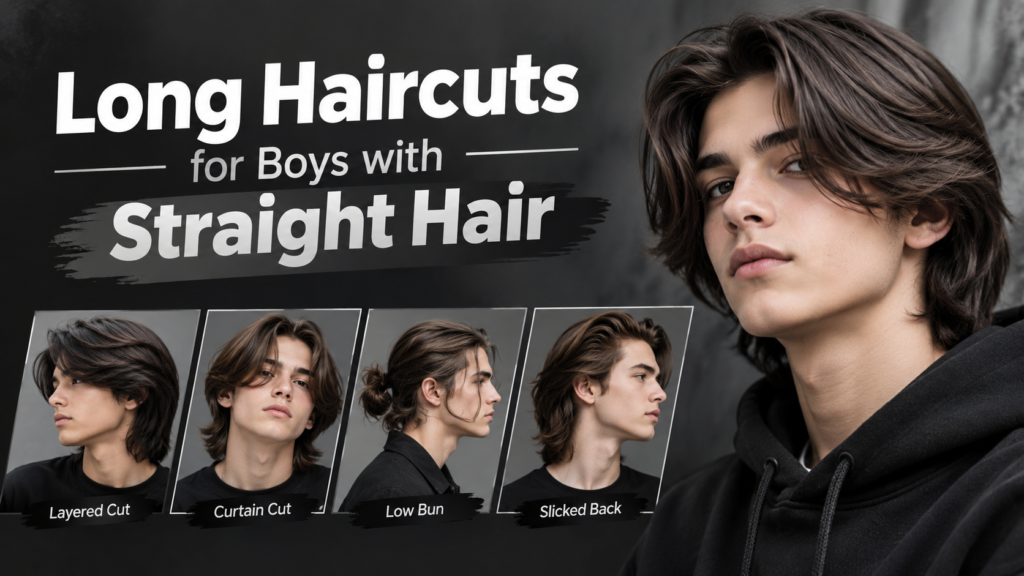
Long straight hair is the hardest to get right. It’s also the one where a good cut matters most. Without shape, long hair hangs like a curtain. With the right layers, it looks deliberate and healthy.
A rule for every long cut: trim every 8 to 10 weeks. Split ends show up fast on smooth, straight strands.
27. Bro Flow
Shoulder-grazing hair, swept back from the forehead with no real parting. It’s relaxed, sporty and very teeny.
- Best for: Teens with medium to thick hair
- Why it works: Straight hair flows back easily and dries smooth
- Needs: Light layers at the front so it doesn’t sit like a flat sheet
28. Ivy League with Length
A longer take on the classic. The top is long enough to part and comb, the sides are tapered, and the shape stays tidy.
- Best for: Boys who want length without the scruffy look
- Why it works: A defined part and tapered sides give structure to long straight hair
- Style: Comb with a light pomade while damp
29. Slicked Back Undercut
Long hair on top combed straight back, with shaved or very short sides. High contrast, high impact.
- Best for: Older teens with thick straight hair
- Why it works: Straight hair slicks back smoothly
- Watch for: Fine hair can look thin when slicked, so use a matte product
30. Layered Shoulder-Skimming Cut
Hair cut with long, face-framing layers that end around the collar. It’s a softer option.
- Best for: Boys who want to grow their hair out properly
- Why it works: Layers stop the “triangle” shape that long straight hair often makes
31. Surf Flow
Loose, tousled, mid-length hair, usually worn pushed back or tucked behind the ears.
- Best for: Boys with straight to slightly wavy hair
- Why it works: A sea salt spray gives grip and movement
- Tip: Skip heavy gel, which kills the loose effect
32. Long Side Part
A deep side part with hair falling long on one side. It’s classic and a little dramatic.
- Best for: Oval and square faces
- Why it works: Straight hair keeps the part clean all day
33. Soft Mullet-Lite
A subtle version of the mullet: slightly longer at the back, cropped around the ears, with a messy fringe.
- Best for: Fashion-forward teens
- Why it works: Length at the back adds interest to flat hair
- Note: Check school rules on back length first
Trendy Boys’ Straight Hair Cuts in 2026
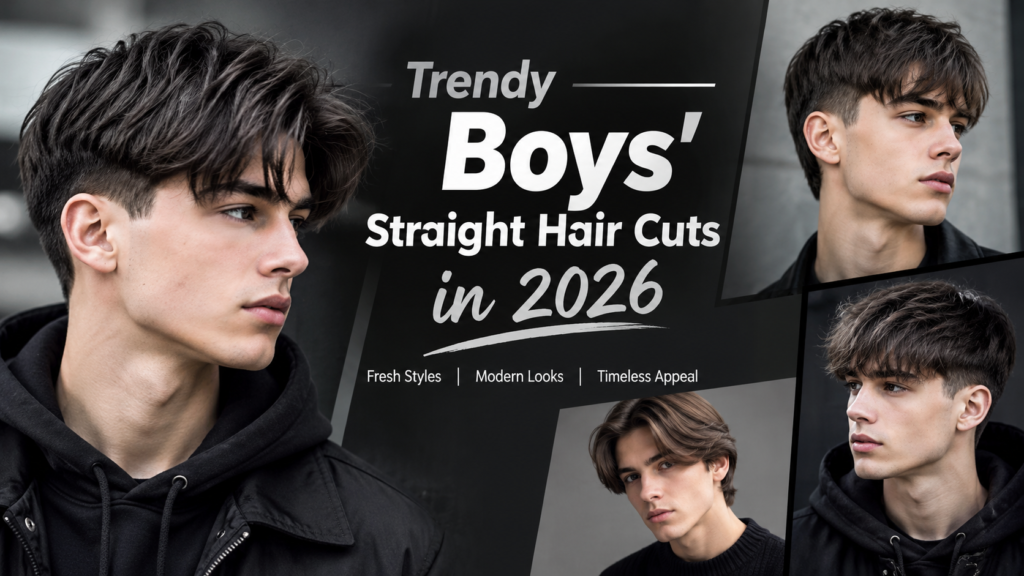
Trends move fast, but a few shapes keep appearing in barbershops this year: soft volume, longer fringes, bolder contrast and a more relaxed, lived-in finish. Here’s what’s worth trying, and what to think twice about.
34. Blowout Taper: An Honest Assessment
The blowout taper pairs a voluminous, blow-dried top with a tapered back and sides. It’s popular, and it looks great in photos.
The honest take: On straight hair, the volume depends almost entirely on the blow-dry. Without a dryer and ten minutes, it flops. If your son will do the work, it’s a winner. If not, choose a textured crop.
- Best for: Teens who enjoy styling
- Needs: Blow-dryer, round brush, light powder or mousse
35. Fluffy Fringe
A soft, feathery fringe that’s slightly longer and lighter than a classic crop. It gives a gentle, boyish look.
- Best for: Fine to medium straight hair
- Why it works: Light layers give airiness instead of weight
- Style: Blow-dry forward with fingers, add a hint of volumising spray
36. Disconnected Undercut
The top is left long and the sides are cut very short, with no blending between the two. The contrast is the point.
- Best for: Thick straight hair
- Why it works: The abrupt step stops thick hair puffing out at the sides
- Caution: Needs regular tidying to keep the line sharp
37. Executive Contour
A polished, business-style cut with a defined part, sculpted sides and a neat outline. It’s a “mini professional” look.
- Best for: Formal events, interviews, older teens
- Why it works: Straight hair holds contours with a bit of pomade
- Style: Comb through, set with a light-shine finish
38. Textured Fringe Mullet
A shorter, tidier mullet with a choppy fringe and tapered sides. It trims down the shock factor.
- Best for: Teens who want something different
- Why it works: Texture breaks up the flat look
39. Micro Fringe Crop
A very short, tight fringe above a clean fade. It’s an update of the Caesar cut.
- Best for: Boys with thick, straight hair
- Why it works: Short fringes don’t need styling, and straight hair keeps them even
40. Soft Modern Bowl
Not the helmet your parents remember. This version is layered, lightly textured and cut shorter at the nape.
- Best for: Younger boys with straight, fine hair
- Why it works: Soft layers remove the heavy line
- Caution: Skip it if your son dislikes a fringe
2026 Trend Snapshot
| Trend | Effort | Longevity | Verdict |
| Blowout taper | High | Medium | Great if he’ll style it |
| Fluffy fringe | Low | High | Safe and cute |
| Disconnected undercut | Medium | Medium | Bold, needs upkeep |
| Executive contour | Medium | High | Smart, timeless |
| Textured fringe mullet | Medium | Low | Fashion-forward |
| Micro fringe crop | Low | Medium | Easy and sharp |
| Soft modern bowl | Low | Medium | Good for younger boys |
What Haircut Suits a 12-Year-Old Boy with Straight Hair?
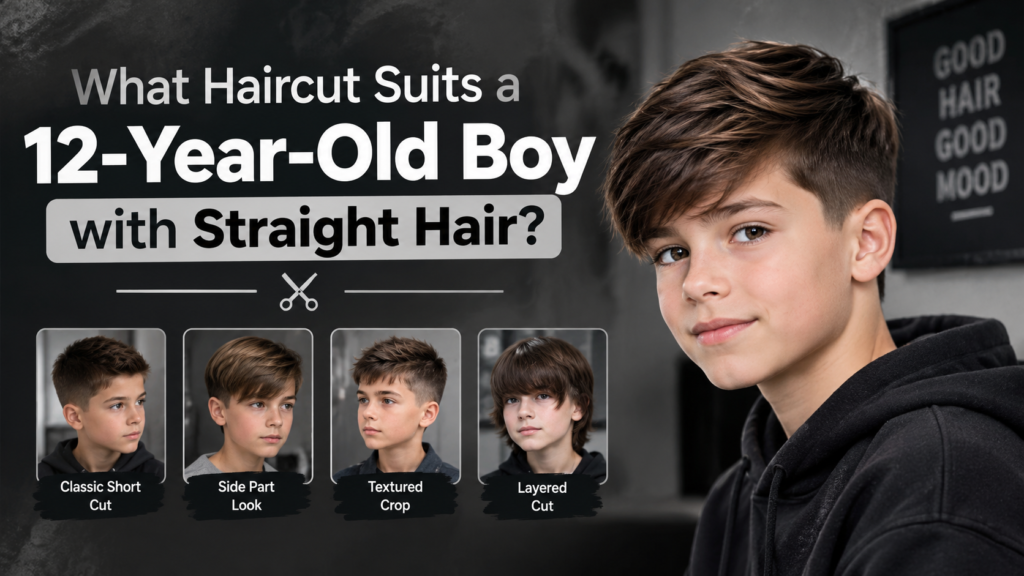
Twelve is a turning point. He’s starting to care what his hair looks like. You’re still managing the budget, the school rules and the morning rush.
The best cut at this age is one that gives him some style, but doesn’t need a long routine.
Best 5 Cuts for 12-Year-Olds with Straight Hair
- Textured crop with mid fade (#1): Modern, neat, simple to style.
- Side swept with fade (#18): Looks grown-up but still age-appropriate.
- Ivy League (short to medium version): Classic and school-friendly.
- French crop (#2): Sharp and low-effort.
- Short quiff (#8): Give height without needing length.
School Dress Code at 12
Most middle schools focus on a few practical rules:
- Hair shouldn’t block vision.
- No extreme colours or unnatural dyes.
- No shaved designs or patterns in some schools.
- Hair must be clean and tidy.
Always read the handbook before the appointment. A cut that breaks the rules can mean a day at home or a forced trim.
What 12-Year-Olds Want vs. What Parents Want
| He wants | You want | A good middle ground |
| Longer top, “flow” | Hair off the face | Medium top with a taper |
| Faded sides | Low cost | A low taper that grows out gracefully |
| Messy, effortless look | Tidy for school | Textured crop |
| Bold change | Safe choice | Start with a small change, then build |
Let him pick from two or three approved options. When kids feel heard, they take better care of the result.
How to Add Texture and Volume to Straight Boys’ Hair
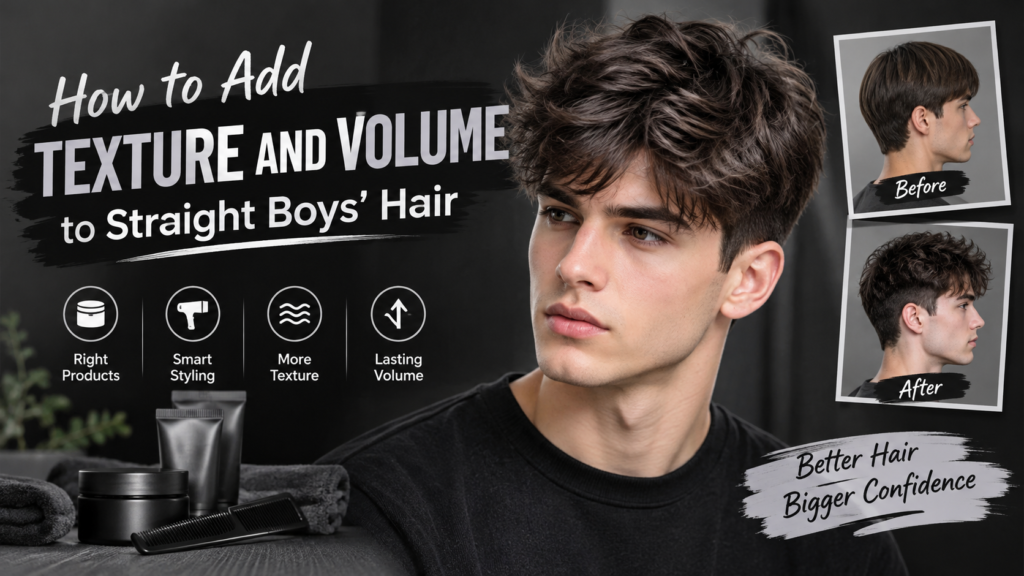
Flat straight hair is fixable. It takes the right cut, the right product and a minute or two with a dryer.
The Right Cut Adds Texture
Texture starts with the scissors. Ask your barber for:
- Point cutting: Snipping into the ends at an angle to create a broken edge.
- Layering: Different lengths so strands support one another.
- Thinning on thick hair: Remove weight, but don’t overdo it.
- A taper or fade: Keeps the sides slim, so the top looks fuller.
Products That Work on Straight Boys’ Hair
You don’t need a bathroom shelf of bottles. Three or four products cover everything.
| Product | What it does | Best for |
| Sea salt spray | Adds grip and a gritty feel | Fine hair, messy styles |
| Matte clay or paste | Gives hold without shine | Textured crops, quiffs |
| Light styling cream | Smooths and defines | Side parts, neat styles |
| Volume powder | Lifts roots, absorbs oil | Fine, flat hair |
| Light mousse | Adds body before blow-drying | Medium-length cuts |
Use a pea-sized amount for kids. For thick hair, a coin-sized amount is the most you’d need.
Blow-Drying Technique for Volume in 3 Minutes
You don’t need salon skills. Try this:
- Start with towel-dried hair. Not soaking, not bone-dry.
- Apply a little mousse or sea salt spray at the roots.
- Set the dryer to medium heat. High heat dries out fine strands.
- Dry the front upward and back, brushing against the direction the hair falls.
- Switch to the direction you want for the last 20 seconds, such as forward for a fringe.
- Finish with a cool shot to set the shape.
- Add a little clay or paste and shape with your fingers.
What NOT to Use on Straight Boys’ Hair
- Strong-hold gel: Leaves a hard, flaky finish.
- Heavy wax or grease: Weighs hair down and looks oily.
- Too much product: It builds up and flattens everything.
- Daily shampoo with harsh formulas: Dries out the scalp and can increase oil production.
- Hot tools every day: Damages fine strands.
How to Tell Your Barber Exactly What You Want
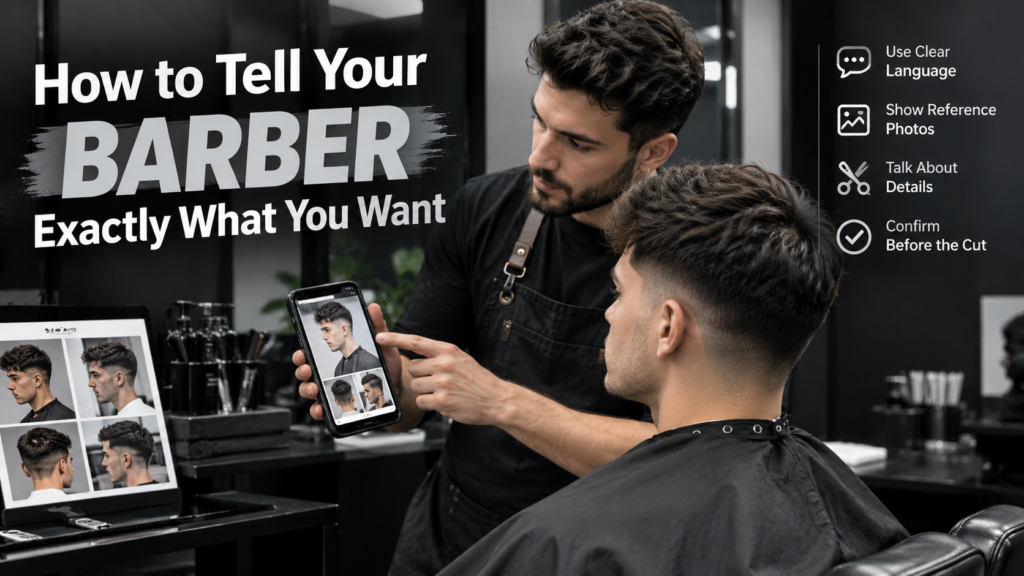
A picture helps, but words matter more than most people think. “Short on the sides” can mean anything from a #1 to a #4 guard. Be specific.
Barber Script for Short Styles
“Can we do a textured crop? I’d like a number 2 guard on the sides, fading into about an inch and a half on top. Please texture the top with scissors and leave the fringe a little longer so he can push it forward. He has a cowlick at the crown, so cut around it.”
Barber Script for Medium Styles
“He wants about three inches on top, with a taper on the back and sides. Please add light layers so it doesn’t sit flat, and leave the fringe long enough to sweep to the side. He’ll blow-dry it in the morning.”
Barber Script for Long Styles
“We’re growing it out. Please trim only the ends and add soft layers around the face. Keep the length at the shoulders. No thinning shears, since his hair is fine.”
The One Thing to Always Mention
Mention the cowlick. A crown swirl or front cowlick changes how every piece of hair lies, and a barber who doesn’t know can cut the hair in a way that sticks up. Point it out at the start and ask the barber to cut with it, not against it.
Other helpful details to share:
- How he normally styles his hair (or doesn’t)
- Whether he wears a helmet or cap often
- The school’s rules on length and fades
- Whether you want it to grow out neatly
School-Safe Straight Hair Cuts That Still Look Good
Schools vary a lot. The safest approach is to read the dress code before booking. But some cuts pass almost any policy.
Cuts That Pass Every Policy
- Crew cut
- Side part with low taper
- Short back and sides
- Ivy League (short version)
- Buzz cut with a natural hairline
- Textured crop (not too long)
What Schools Actually Ban
Common restrictions include:
- Unnatural colours such as blue, green or bright blonde streaks
- Shaved patterns, lines or words in the hair
- Extreme mohawks or spikes
- Hair that hides the eyes
- Length that touches the collar (in stricter schools)
A fade itself is rarely the problem. A very high skin fade with a hard part can be, so check.
Middle School vs High School Rules
| Area | Middle school | High school |
| Length rules | Often stricter | More relaxed |
| Colour | Usually banned | Often allowed if natural-looking |
| Fades | Usually fine | Fine |
| Designs and lines | Commonly banned | Varies |
| Hats | Often not allowed | Varies |
How Often Should Straight Hair Boys Get a Haircut?
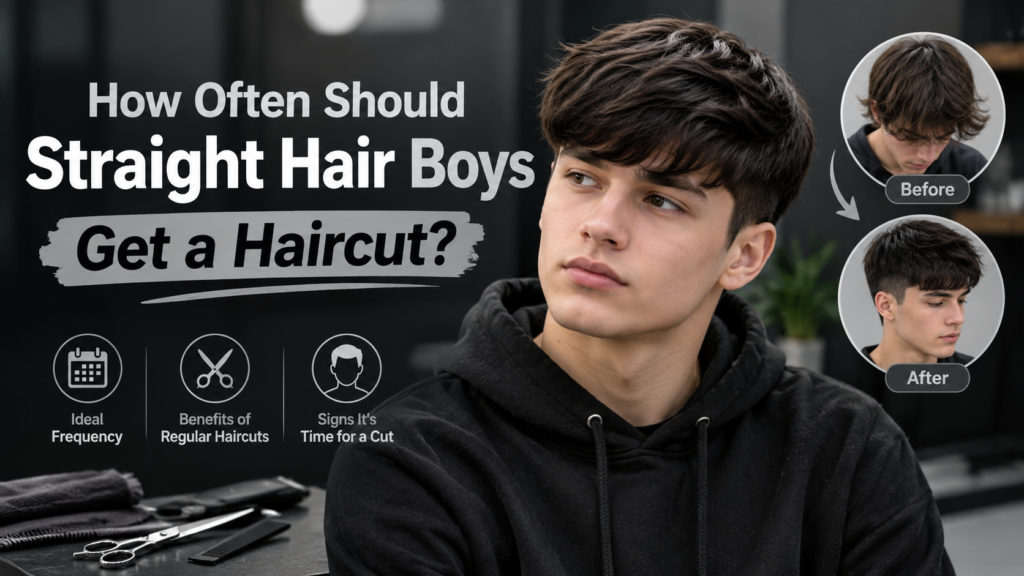
Straight hair shows grow-out faster than any other texture. The shape softens quickly, and edges look scruffy within a few weeks.
| Cut type | Recommended frequency |
| Buzz cut, crew cut | Every 3–4 weeks |
| Fades and tapers | Every 2–3 weeks |
| Textured crop, French crop | Every 3–4 weeks |
| Side part, Ivy League | Every 4–5 weeks |
| Medium length | Every 5–6 weeks |
| Long hair | Every 8–10 weeks |
Cost Over a Full Year
Prices vary hugely by city and barber. Here’s a simple example using $20 per cut as a baseline, so you can swap in your own number:
| Cut type | Cuts per year | Yearly cost at $20 |
| Fade every 3 weeks | ~17 | ~$340 |
| Textured crop every 4 weeks | ~13 | ~$260 |
| Side part every 5 weeks | ~10 | ~$200 |
| Medium length every 6 weeks | ~9 | ~$180 |
| Long hair every 9 weeks | ~6 | ~$120 |
Fades cost the most because they need the most frequent upkeep. If budget matters, a scissor-cut style or a crew cut is cheaper in the long run. A home clipper kit can also handle quick tidy-ups between visits.
Signs It Needs a Trim Now
- The fringe touches his eyelashes
- Hair curls over the ears
- The neckline looks fuzzy
- The part line has disappeared
- Styling takes longer than usual
- The top looks flat, even after product
5 Myths About Straight Boys’ Hair (and the Truth)
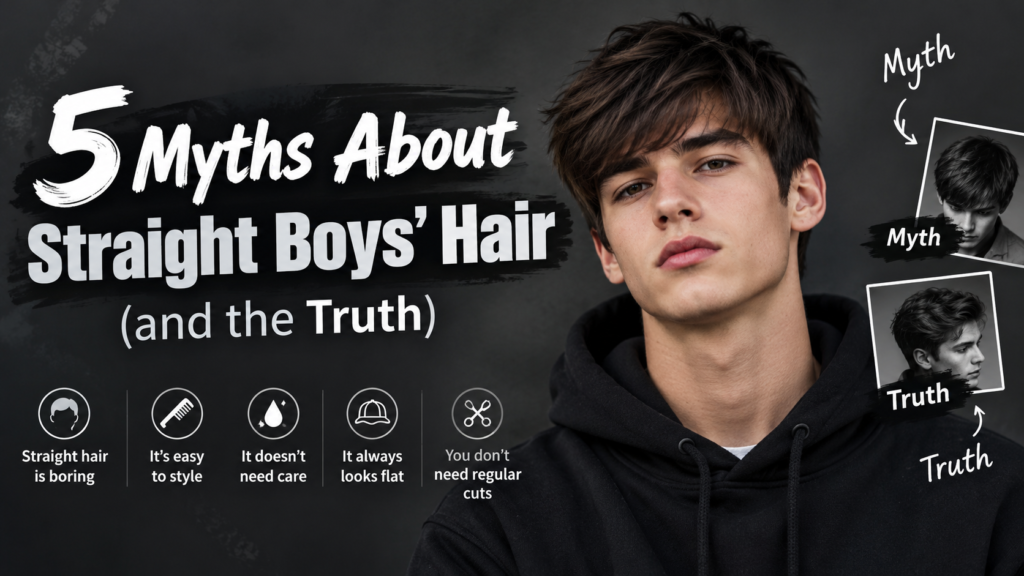
A lot of bad haircut decisions start with a wrong assumption. Here are the five we hear most often.
Myth 1: “Straight hair doesn’t need a good barber.” It needs one more than any other texture. There are no curls to hide uneven layers, so a rushed cut shows up straight away.
Myth 2: “Fine straight hair can’t hold a style.” It can, if the cut is short enough and the product is light. Heavy gel is the real culprit, not fine hair.
Myth 3: “Thick straight hair is always easy.” Thick, coarse straight hair can puff out at the sides and sit like a helmet. It needs thinning, tapering or a disconnected shape to look neat.
Myth 4: “A cowlick means the cut is ruined.” A cowlick is just a growth pattern. A skilled barber cuts around it, or uses it to create lift at the front.
Myth 5: “Long hair is lower maintenance because you cut it less.” You visit less often, but you need more daily care: brushing, conditioning the ends and regular trims to prevent split ends.
Quick-Pick Guide: Match Your Son to a Cut
Not sure where to begin? Find the sentence that sounds most like your son, then jump to the cut number.
| If your son… | Try this cut | Cut # |
| Hates styling and wants zero effort | Crew cut or buzz cut | 4, 6 |
| Has fine, flat hair that never lifts | Textured crop or short quiff | 1, 8 |
| Has thick hair that puffs out at the sides | Two block or disconnected undercut | 16, 36 |
| Plays sport every day | High and tight or brushed-up side part | 11, 25 |
| Wants to look neat for school photos | Side part with low fade | 3 |
| Is growing his hair out | Long-top taper or Ivy League with length | 26, 28 |
| Loves trends and enjoys styling | Blowout taper or comma hair | 34, 17 |
| Hates hair in his eyes | Caesar cut or French crop | 7, 2 |
| Has a round face | Taper fade with brush-up | 9 |
| Has a long, narrow face | Curtain bangs or messy fringe | 15, 22 |
If two rows fit, pick the cut with the lower effort. A style that’s easy to repeat always looks better than a trendy one that’s styled badly.
Two-Minute Styling Routines by Cut Type
Most boys won’t spend ten minutes on their hair. These quick routines take two minutes or less.
For Short Cuts (Crop, Crew, Caesar)
- Wet the hair lightly, or start with towel-dried hair.
- Rub a pea-sized amount of matte paste between your fingers.
- Push the fringe forward, then shape the top with your fingertips.
- Leave it alone. Over-touching makes it greasy.
For Medium Cuts (Side Swept, Quiff, Curtain Bangs)
- Spray a little sea salt spray or mousse at the roots.
- Blow-dry the front up and back for 60 seconds.
- Switch to the final direction (side or forward) for another 30 seconds.
- Finish with a light cream or clay and shape with your hands.
For Long Cuts (Bro Flow, Surf Flow, Long Side Part)
- Comb through damp hair while it’s still wet.
- Apply a small amount of leave-in spray or cream to the mid-lengths and ends.
- Air-dry, or dry on low heat while pushing the hair back.
- Tuck, part or sweep as needed.
Quick Fixes for Bad Hair Mornings
- Hair sticking up at the back: Wet it, press it flat with a towel, then dry on low.
- Flat top: Add volume powder at the roots and lift with your fingers.
- Greasy look: A tiny amount of dry shampoo or powder at the roots soaks up oil.
- Frizzy flyaways: Smooth a drop of cream over the top with your palm.
Matching the Cut to Your Son’s Lifestyle
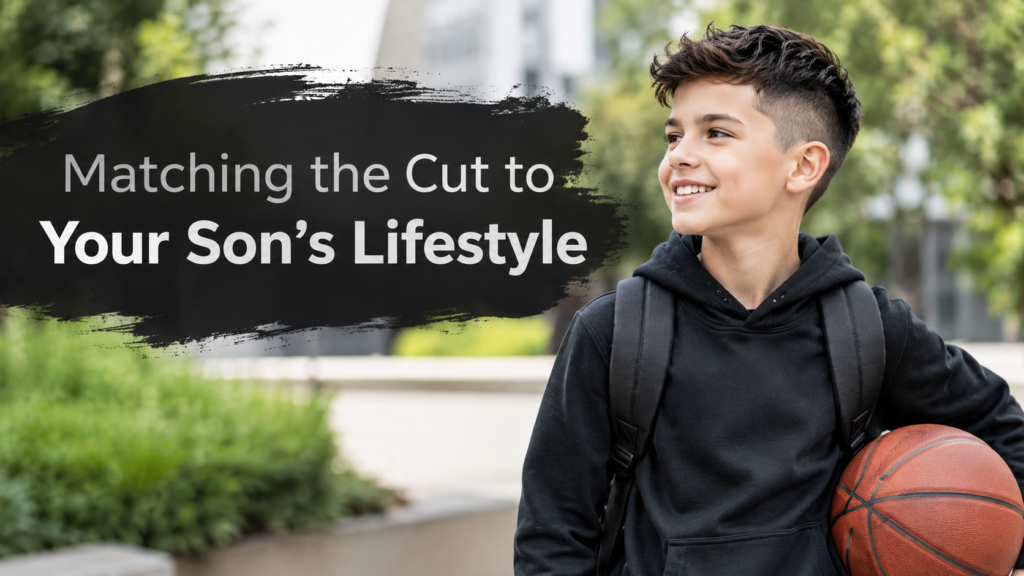
A haircut has to survive real life. Think about what your son actually does all day.
Sports and Active Boys
Choose short, tapered cuts that stay put under a helmet or cap. The crew cut, high and tight, and short textured crop all work well. Long fringes get sweaty and irritating.
Swimmers
Chlorine dries out straight hair and can make it brittle. Short cuts need less rinsing, and a quick conditioner after each swim helps keep the hair smooth.
Creative and Fashion-Minded Boys
These boys often enjoy a bolder shape. Let them try a disconnected undercut, a textured fringe mullet or curtain bangs, as long as the school allows it and he agrees to keep the shape tidy.
Quiet, Low-Maintenance Boys
A classic side part, a Caesar cut or a short back and sides gives a neat result with almost no thought. These cuts also grow out predictably.
Summer vs Winter
| Season | What works | Why |
| Summer | Buzz cut, crew cut, short crop | Cooler, quicker to dry, less sweat |
| Winter | Textured crop, side swept, medium cuts | A little extra length keeps the head warmer |
| Rainy season | Short cuts with texture | Straight hair goes limp in humidity, and short hair resists it better |
Everyday Care for Straight Boys’ Hair
A great cut fades fast without a simple routine. The good news is that straight hair needs less care than most textures. It just needs the right kind.
Washing and Conditioning
- Wash 2 to 3 times a week for most boys. Teens with oilier scalps may need every other day.
- Use a gentle shampoo. Harsh formulas strip the scalp and make oil production worse.
- Condition the ends only. The conditioner at the roots makes fine straight hair flat.
- Rinse with cool water at the end to help the hair lie smooth.
Night and Morning Habits
- Dry the hair before bed, since sleeping on damp hair creates odd kinks and cowlick lines.
- Wet the front and re-comb it in the morning to reset the shape.
- Keep a small comb in the school bag for quick fixes.
Common Mistakes Parents Make
| Mistake | Better move |
| Choosing a cut from a photo of curly hair | Pick photos of straight-haired boys with a similar thickness |
| Asking for “just a trim” with no detail | Say the guard number and the top length |
| Using too much product | Start with a pea-sized amount |
| Waiting too long between cuts | Book the next visit before leaving the chair |
| Ignoring the cowlick | Point it out at the start of every appointment |
| Letting a fade grow into a mop | Switch to a taper, which grows out more gracefully |
When to Try Something New
If your son keeps asking for a change, test it in small steps. Move from a crew cut to a textured crop. Then add a taper. Then try a longer fringe. Straight hair grows back at about half an inch a month, so a small mistake is never permanent.
Frequently Asked Questions
What is the best haircut for a boy with straight hair?
The textured crop is the most reliable choice. It adds natural lift, needs little styling and works for most ages and face shapes.
What haircut makes straight hair look thicker?
Short, layered cuts with a taper or fade work best. They remove weight from the sides and give the top more body.
How do you add volume to flat straight hair for boys?
Cut it shorter on top, add texture with point cutting, then blow-dry upward with a little mousse or sea salt spray.
Is a fade good for straight hair?
Yes. Straight hair holds a clean fade well, though the blend lines show quickly, so you’ll need a trim every 2 to 3 weeks.
What is the best short haircut for boys with straight hair?
The French crop and the textured crop are the top picks. Both stay neat, keep hair out of the eyes and need very little product.
What haircut is best for a 12-year-old boy with straight hair?
A textured crop with a mid fade is a safe, stylish choice. The side swept with fade and the short Ivy League are also strong options.
What are good haircuts for teens with straight hair?
Teens can try the two block, comma hair, curtain bangs with a taper or a textured quiff. These give shape and style without looking childish.
Which haircut is easiest to maintain on straight hair?
The crew cut and the buzz cut. They need no styling and look tidy for weeks.
How do I stop straight hair from sticking up?
Check for a cowlick and ask the barber to cut around it. A little cream or paste on damp hair keeps stray pieces in place.
What products are best for boys with straight hair?
Matte clay, light cream, sea salt spray and a little volume powder. Avoid heavy gel and greasy wax.
How often should I cut my son’s straight hair?
Short styles need a cut every 3 to 4 weeks. Longer styles can wait 6 to 10 weeks.
Can boys with straight hair grow it long?
Yes, if it’s layered and trimmed regularly. Without layers, long straight hair tends to look flat and stringy.
Conclusion
The best boys’ haircuts for straight hair do three things: they add texture, they control the sides, and they fit how much effort the boy will actually put in.
Here’s the short version:
- Young kids: Crew cut, short back and sides, or soft crop
- Pre-teens: Textured crop with a mid fade, or side swept with fade
- Teens: Two block, comma hair, curtain bangs, textured quiff
- Low effort: Buzz cut, butch cut or Caesar cut
- Dress-code friendly: Side part with a low taper
Before your next appointment, do three things. Pick two or three cuts from this list. Tell the barber about the cowlick. And ask for a style he can handle in two minutes on a school morning.
Straight hair may start out flat, but with the right cut it ends up being one of the easiest textures to look good with. Choose a style, save a photo, and book that appointment.
Prices, school rules and trends differ by place and change from year to year. Check your local barber and your school’s handbook before you book.

Jasper Cole is a content writer and researcher at Faxhion Infoz, focusing on hair care, hairstyles, styling ideas, and hair related topics. He researches information from reliable sources and presents practical insights in simple language. His goal is to help readers better understand hair care and make informed everyday choices.